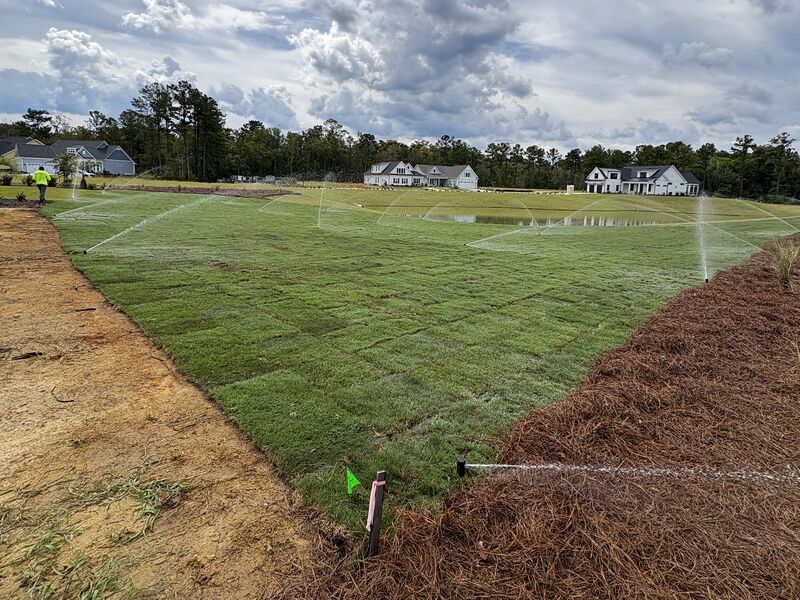
Irrigation systems rarely die all at once. They fail one head, one valve, one wire at a time — and the lawn pays the bill quietly until a hot week makes the damage obvious. The frustrating part: most of these failures are cheap to fix when caught early. After 15 years of repairing systems of every age and brand along the Carolina coast, these are the five warning signs we tell every homeowner to watch for.

A lawn that browns evenly is thirsty everywhere — that is a scheduling problem. A lawn with crisp brown patches, arcs or crescents in otherwise green turf is telling you exactly where coverage died: a clogged nozzle, a head knocked out of alignment by the mower, or a seized rotor that stopped rotating. In sandy coastal soil the symptom appears fast, often within days. The fix is usually a single head or nozzle — if it is done before the turf in that patch gives up completely.
Water has to go somewhere. A permanently damp patch, moss, or a strip of suspiciously lush dark-green grass usually marks a leaking lateral line or a valve that no longer closes fully. The other tell is on paper: if your water bill climbed over a season without a rate change, the system is probably bleeding underground. Left alone, leaks erode soil, drown roots, and can undermine walkways — a small dig-and-repair now beats a landscape repair later.
Healthy heads rise fully and throw a steady, defined stream. Heads that sputter or spit usually have debris in the nozzle or a failing seal. A fine mist that drifts away on the breeze means pressure is too high — water is literally evaporating instead of landing. Heads that barely rise or immediately sag mean pressure is too low: a leak, a partially closed valve, or too many heads jammed onto one zone. Each has a specific, inexpensive fix; all of them waste water every single cycle until repaired.

When one zone plays dead while the rest run fine, the culprit is almost always electrical or a stuck valve: a broken solenoid, a chewed or corroded wire, or a diaphragm that failed inside the valve body. The reverse — a zone that keeps weeping water after the cycle ends — is a valve not seating, and it will drown that section while starving your water bill. Valve work is bread-and-butter repair for us: locate, diagnose, replace, retest, usually in a single visit.
Plenty of systems run on a schedule set years ago by someone who no longer lives there. Seasons change, plants mature, sod gets added — and the controller keeps running its ghost schedule. If you do not know what your controller is doing, it is almost certainly overwatering somewhere and underwatering somewhere else. A tune-up visit reprograms zones for the current landscape and season; upgrading to a modern controller adds rain sensing so the system stops watering in a thunderstorm.
Honest rule of thumb: if the pipes and valves are sound, almost everything else is worth repairing — heads, nozzles, solenoids, wire and controllers are all replaceable parts. We recommend replacement only when a system was designed wrong from the start (chronic pressure problems, no head-to-head coverage) or when repairs would exceed half the cost of doing it right. Either way you get the numbers first, in writing, before any work starts.

Most single-issue repairs — a head, a nozzle, a solenoid — are quick, inexpensive fixes. We diagnose on-site and give you the price before we touch anything.
Yes, all the time. We work on residential and commercial systems of any age and any brand from Myrtle Beach to Wilmington.
Twice a year is ideal on the coast: a spring startup to test every zone before the heat, and a fall check to adjust schedules for cooler weather.
Usually a coverage or pressure problem in that zone — a stopped rotor, clogged nozzles, or too many heads on the line. It is one of the most common and most fixable calls we get.
Yes — beds, new sod areas and expansions can usually be tied into your existing system with a new valve and zone, properly sized for the pressure available.
If any of these five signs sounds like your yard, do not wait for the August heat to make it worse. JP Landscapes repairs and installs irrigation systems across the Carolina coast, from Myrtle Beach to Wilmington — fast diagnosis, straight answers, written pricing. Call or text Jesse at 910-640-7660, request a repair visit, or read about everything else we do for coastal lawns.