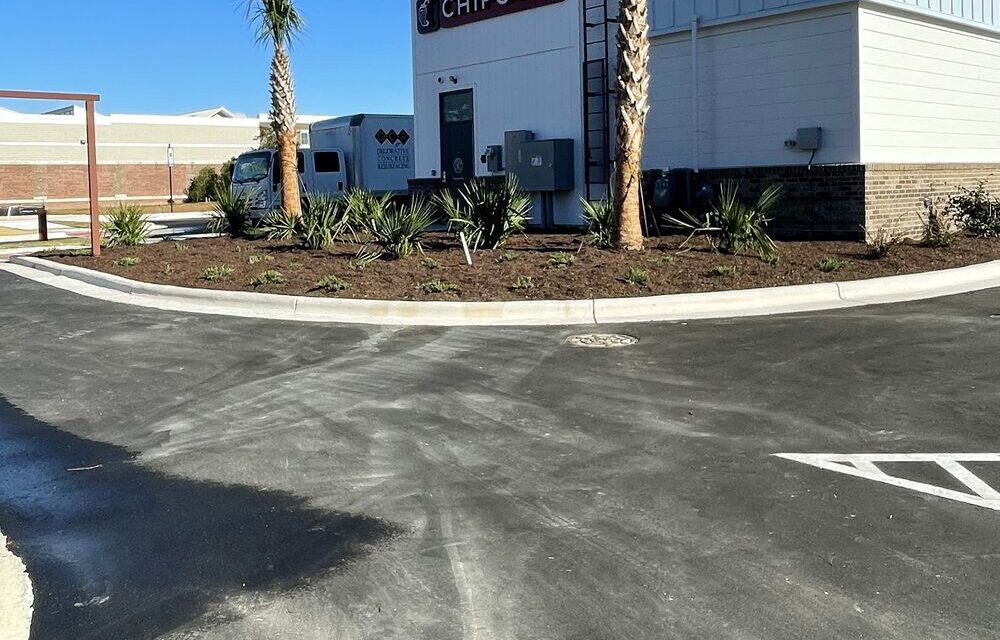
Customers judge a business from the parking lot. Before they taste the food, browse the shelves or meet the staff, they see the entrance, the islands, the beds along the frontage — and they form an opinion in seconds. That is why national brands spend real money on landscaping, and why local businesses on the Carolina coast should too. We have installed commercial landscapes for storefronts, restaurants and entire communities from Myrtle Beach to Wilmington. Here is what separates commercial work that lasts from planting that gets replaced every spring.

Commercial landscaping is marketing you only pay for once. A crisp entrance tells customers the business is cared for; a weedy island quietly says the opposite. Studies aside, coastal retail lives on drive-by traffic — your frontage is a billboard on Highway 17 whether you treat it like one or not. Palms with clean bed lines, healthy plantings and mulch that stays put are the visual shorthand for a business worth stopping at.
A commercial site is a harder environment than any backyard: reflected heat off asphalt, compacted subsoil, salt and sand blown across open lots, foot traffic cutting corners, and irrigation that must run reliably with nobody watching it. Designs that ignore this die by August. Ours start with it — soil correction in every island, tough salt-tolerant plant palettes, and automatic irrigation zoned per bed so a broken head in one island never dries out the whole frontage.

The three zones that matter most: islands, entry and frontage. Parking islands are brutal — heat from three sides, doors swinging into shrubs, cart traffic — so we build them with palms for height, low tough shrubs and grasses below sight lines, and mulch or rock that will not wash across the asphalt in a storm. Entrances get the showpiece treatment, since that is where customers slow down. Street frontage is about rhythm: repeated palms and bed shapes that read at 45 miles per hour and make the whole property look organized.

Coastal commercial sites call for plants that tolerate salt, heat, drought between irrigation cycles, and the occasional bumper. Palms are the workhorses — they own a small footprint, never block signage, and shrug off wind. Around them: ornamental grasses, dwarf hollies, and other compact evergreens that keep their shape with two or three trimmings a year instead of constant attention. The goal is a landscape whose maintenance bill stays predictable — because on commercial property, maintenance is the real long-term cost.
Commercial projects fall apart in the handoffs — the grading contractor blames the irrigation sub, who blames the planting crew. We do it as one scope: grade the islands and swales so storm water goes where it should, trench and install irrigation while the ground is open, then plant and finish. One contract, one schedule, one call if anything needs attention. For property managers and franchise owners, that accountability is worth as much as the plants.
Yes — new builds are a specialty. We work from your site plan or landscape drawings, coordinate with the GC, and handle grading, irrigation, planting, sod and ground covers as one package.
In most cases yes. We phase work by area, keep entrances open, and schedule the messiest steps for your slowest hours or days.
It scales with site size, plant sizes and irrigation scope. We quote from a site walk or plan set — free and itemized, so you can adjust scope before work starts.
Yes, full systems with controllers, zone design and backflow — plus repairs on existing systems that have stopped covering properly.
We do — community entrances, amenity centers, streetscapes and common areas across the Myrtle Beach–Wilmington corridor.
If your storefront, restaurant, office or community entrance is not saying what you want it to say, we can fix that. JP Landscapes designs and installs commercial landscaping — grading, irrigation, palms, plantings, sod, rock and pine straw — across coastal NC & SC. Call or text Jesse at 910-640-7660, request a free site walk, or see commercial projects in our gallery.