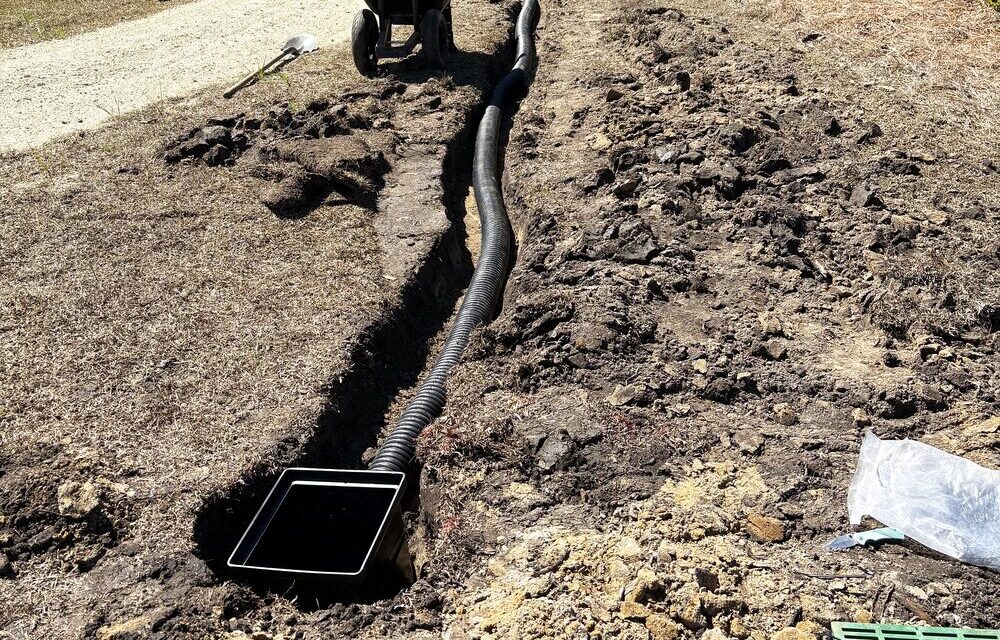
If part of your yard stays wet for days after a storm — or your crawl space smells musty and your mulch keeps washing into the lawn — you do not have a grass problem. You have a water problem. On the Carolina coast, where summer downpours can drop inches of rain in an hour, drainage is the least glamorous and most important thing we build. The two workhorses are gutter drains and French drains, and homeowners mix them up constantly. Here is the difference, and how to know which one your property needs.

Three usual suspects. First, roof water: an average roof sheds hundreds of gallons in a single storm, and if downspouts just dump at the foundation, that water saturates the soil right where you least want it. Second, grading: many lots — especially newer builds — settle or were finish-graded in a hurry, leaving low pockets with nowhere to drain. Third, soil layering: even in sandy coastal ground, a compacted or clay-streaked layer a foot down can hold a hidden bathtub of water under your turf. Most soggy yards we fix have at least two of these going on at once.
A gutter drain — also called a downspout or stormwater drain — is a buried solid pipe that catches roof water at each downspout and carries it away from the house to a safe discharge point: a pop-up emitter at the curb, a swale, or daylight at a lower spot on the property. Because the pipe is solid, its whole job is transport. It fixes water at the foundation, soaked beds along the house, washed-out mulch, and that swampy strip beside the driveway. On many projects we also set yard catch basins — grated inlets in low spots — that tie into the same buried line.

A French drain solves a different problem: water that is already in the ground. It is a trench dug to the right depth and pitch, lined with fabric, filled with washed stone, and fitted with a perforated pipe. Groundwater seeps in through the stone and perforations and gets carried away before it can pond under your lawn. This is the fix for yards that squish for days after rain, for water creeping toward a slab or crawl space, and for those permanently soft areas where the mower leaves ruts. The details decide everything: wrong depth, no fabric, or a flat pipe and the drain clogs or holds water instead of moving it.

A quick field test we use: watch where the water comes from. If puddles form during rain near downspouts and against the house, and mostly disappear within hours, roof water is the culprit — you likely need gutter drains. If the ground stays saturated for a day or more after the sky clears, groundwater is the culprit — that is French drain territory. Many coastal properties honestly need both, tied into one buried system with a single discharge point. And sometimes the real fix starts with regrading: no pipe can beat a lawn that slopes toward the house.
Expect a locate call before digging, trenches cut at a consistent fall (we target about a quarter inch per foot or better), solid pipe for roof water and perforated pipe wrapped in stone and fabric for groundwater, cleanouts where lines run long, and a discharge point that will not create a new problem for you or your neighbor. Then the part most people never see: the lawn goes back together — soil, grade, and fresh sod over the scar — so in a month you cannot tell we were there. Except that the yard finally dries out.
It depends on trench length, depth, obstacles like roots and utilities, and the discharge point. After a walk of the property we give a firm written quote — free, with no obligation.
Temporarily there is a trench, but a professional install puts the yard back together with proper soil and fresh sod. Within weeks the line disappears into the lawn.
Most residential gutter-drain or French-drain systems are done in one to three days, weather permitting, including cleanup and sod repair.
Surface extensions help a little, but they are trip hazards, mower obstacles, and they freeze, crush and detach. A buried system with the correct pitch is a permanent fix.
Yes. Grading and drainage are one conversation — we regrade low spots and slopes as part of the same project, so water moves the way it should on the surface and underground.
Standing water does not fix itself — it finds your foundation. JP Landscapes designs and installs gutter drains, French drains, catch basins and grading corrections across the Carolina coast, from Myrtle Beach to Wilmington. Call or text Jesse at 910-640-7660 or send us a photo of your problem spot through the quote form, and we will tell you exactly what we would do — and what it costs. You can also browse all our services.